


New Orleans, Big Ideas, and an Uncomfortable Truth About Leadership

What I learned at the Meat Institute’s Solutions Summit about the future of our workforce, the power of better questions, and why we can’t afford to settle for average.
Last week, I went to New Orleans for the first time.
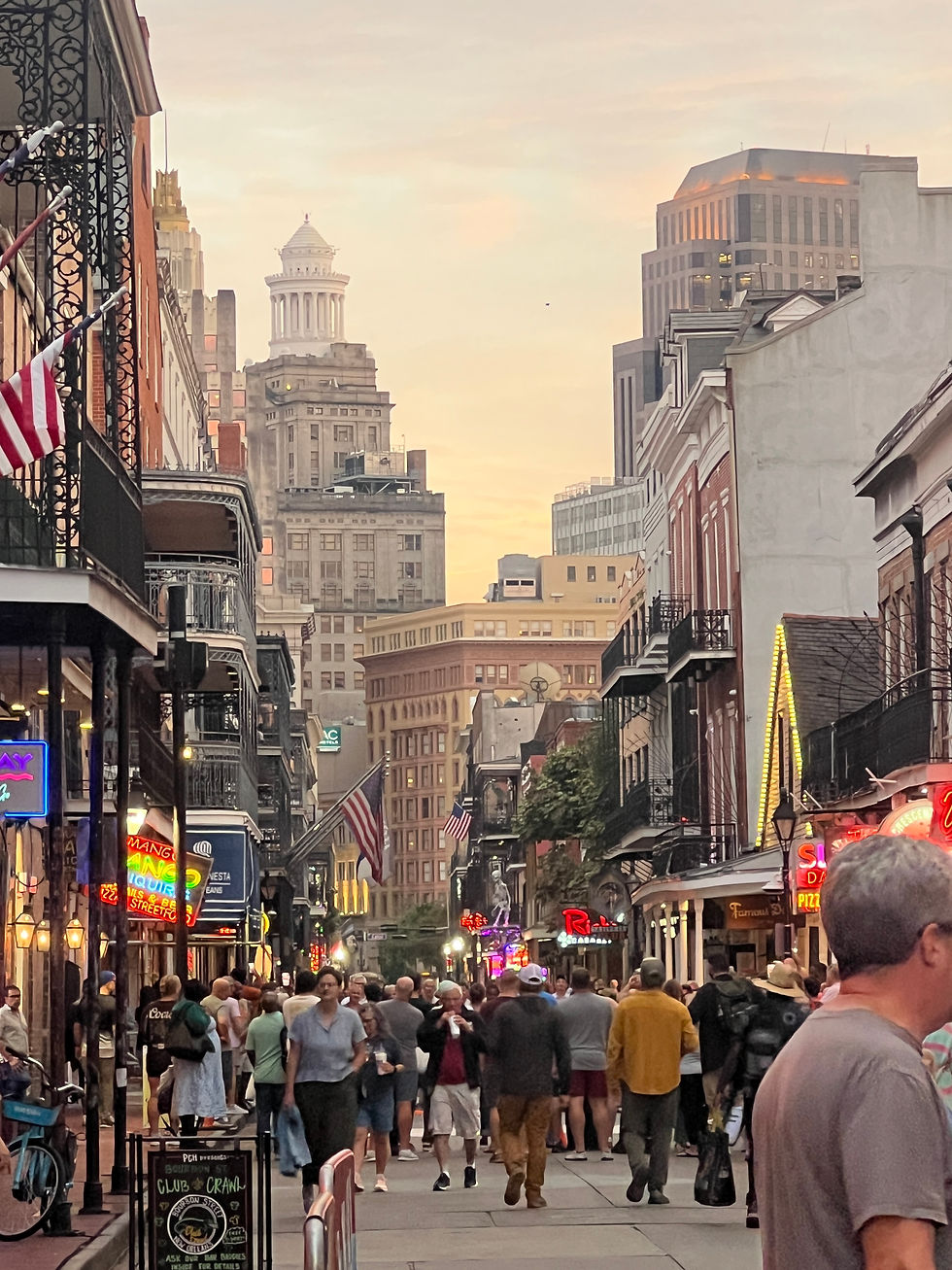
It’s a place I’d wanted to visit for years, and I finally had the opportunity as emcee of the Meat Institute’s Solutions Summit. I also had the privilege of facilitating the final leadership development workshop for this year’s Emerging Leaders class.
I came home with a few new favorite foods, some excellent conversations, a deeper appreciation for the people who make our food system work, and a handful of ideas I haven’t stopped thinking about.
But first, let’s talk about the oysters.
New Orleans was nothing like I’d pictured in my mind. Not in a bad way. Just different. The narrow streets, neon signs, slushy bars, tourists, and Halloween vibes in the French Quarter were captivating. I thought I might be hesitant to venture out on my own, but I spent two evenings exploring and never felt unsafe.

And the food. Holy Hannah, the food.
My Uber driver recommended Acme Oyster House on my first night. While I was waiting in line, the couple behind me insisted I try the chargrilled oysters. I’d fully intended to order my usual favorite: raw oysters. But I decided to listen to people who knew something I didn’t.
Best decision of the night.

Possibly one of the best meals I’ve ever eaten.
I almost went back the next evening, but the line was too long. A tragedy, really.
I also made the obligatory stop at Café du Monde for beignets, sitting near the Mississippi River and watching the riverboats go by as I enjoyed every bite. When I finished, I was covered in powdered sugar from head to toe and perfectly content.
There’s something about traveling somewhere new that reminds me how much we miss when we assume we already know what to expect. Sometimes the best experiences happen when we get curious, listen to someone else’s perspective, and are willing to try something different.
That lesson followed me into the conference.
My trip was cut short by the looming threat of Hurricane Isaias, and despite leaving New Orleans Thursday instead of Friday, I still managed to get stranded in Chicago overnight after a delayed United flight caused me to miss my connection. I spent some quality hours in the terminal before boarding a 5 a.m. flight and finally making it home to Lincoln around 10:30.
Travel is not always glamorous. But the oysters, the people, and the ideas were worth it.
Here are a few of the things I’m still thinking about.
1. We have a leadership problem hiding inside a workforce problem.
We know hiring and retaining good people is getting harder. The meat industry is not alone in that challenge, but the stakes are significant when you consider the knowledge, skills, and experience required to keep operations running safely and effectively.
The Meat Institute shared findings from its frontline succession research that should make every leader pause.
One statistic particularly caught my attention: only 6% of Gen Z respondents reportedly expressed interest in leadership.
Six percent.
I grew up in a generation where it often seemed like everyone wanted to become the boss. Today, the appetite for leadership appears dramatically different.
We can debate why. Maybe younger employees have watched leaders sacrifice their personal lives, shoulder impossible expectations, or get blamed for problems they didn't create. Maybe the traditional leadership career path doesn't look nearly as attractive as organizations assume it does.
Whatever the reasons, we should be asking questions instead of making assumptions.
Why don't more people want to lead?
What are we showing them about what leadership actually looks like?
And what would make the opportunity worth pursuing?
Because here's the other uncomfortable reality: we're not doing a particularly good job preparing the people we promote.
The research shared at the summit indicated that only 45% of new supervisors receive formal leadership training during their first year on the job, while nearly one in four have never received leadership training at all.
Think about that.
We take someone who may be excellent at their technical job, promote them into a role where they're responsible for other human beings, and then often leave them to figure it out.
We wouldn't expect someone to operate complicated equipment without the appropriate training. Why do we expect them to lead people without it?
Technical competence and leadership competence are not the same thing.
And before we promote someone, we need to determine whether they actually WANT to lead others. Being the best individual contributor doesn't automatically make someone the right person to manage a team. Nor should promotion be the only way to reward a high-performing employee.
We need to create better pathways for people to grow, whether that means leading teams, developing specialized expertise, or contributing in other valuable ways.
If we want stronger organizations, we need to stop treating leadership development as a nice-to-have benefit and start treating it as essential infrastructure.
The question isn't simply whether we can find people to fill leadership positions.
It's whether we're creating the kind of culture, opportunity, and support that makes capable people want those positions in the first place.
2. Better leaders ask better questions. Then they listen to the answers.
One of my favorite sessions featured Jarrod Gillig, SVP and Managing Director of Beef at Cargill.
He shared a story about a leader who asked him a question as he prepared to lead his team through a significant change:
"Who else have you talked to about this change?"
Simple. Powerful. A little uncomfortable if you're accustomed to making decisions in your own head and then announcing them to everyone else.
The question challenged him to widen his circle, gather more perspectives, and improve the information informing his decisions.
That's a leadership lesson worth remembering.
Too often, we develop an idea, get attached to it, and start building a case for why it's right. We surround ourselves with people who agree, move forward, and wonder why implementation is harder than expected.
What if we got curious sooner?
Who sees this differently?
Who will be affected by this decision?
Whose expertise are we missing?
What might someone closer to the work know that we don't?
Better information leads to better decisions. And better information often comes from people who see the problem differently than we do.
Jarrod also shared another question that deserves a permanent place in every leader's toolkit: "What has to be true?"
What has to be true to protect employees?
What has to be true to serve customers well?
What has to be true to find common ground?
What has to be true today for us to be stronger tomorrow?
I love this because it shifts the conversation from defending positions to identifying conditions for success.
Instead of arguing about whether an idea is good or bad, we start exploring what needs to happen to make it work. Instead of treating disagreement as resistance, we look for the information it might reveal.
A few other observations from Jarrod stuck with me:
Do you allow people to challenge your assumptions?
Comfort is not a resilience strategy.
Resilience is built when we connect perspectives.
Stewardship is not passive.
Let ideas move.
Stability can hide weakness.
That last one is especially important.
Just because something is working today doesn't mean it's preparing you for tomorrow. A stable organization can still be losing ground, avoiding difficult conversations, or relying on practices that no longer serve it.
The absence of an obvious crisis is not proof that you're moving in the right direction.
Leadership requires the courage to question what's working, not just fix what's broken.

3. Animal welfare isn't a department. It's everyone's responsibility.
Another important conversation focused on animal welfare and its place on the executive agenda.
The session shared that 70% of consumers consider how their food is raised, while only about half have a positive perception of animal agriculture.
That leaves plenty of room for concern, misunderstanding, and improvement.
But here's where I think the conversation needs to go further.
Why are we treating animal welfare as a question of whether executives should be talking about it?
Of course they should.
Animal welfare is everyone's issue. When something goes wrong, the consequences don't stay neatly contained within one department. Employees, producers, processors, customers, and the broader industry can all feel the impact.
That means the conversation needs to happen at every level.
Executives need to establish expectations and allocate resources. Mid-level managers need to translate those expectations into everyday practices. Frontline employees need the training, tools, and confidence to recognize problems and act appropriately.
Training matters. Recertification matters. Accountability matters.
And complacency is dangerous.
The industry also needs to keep investing in research that reflects the realities of today's production and processing systems. Cattle are larger than they were in the past, and that trend has implications for transportation, handling, equipment, and bruising.
Those challenges deserve thoughtful, evidence-based attention.
Doing the right thing isn't a public relations strategy. It's a responsibility.
And it cannot be delegated away.
Animal welfare matters to the industry, AND it needs to be embedded in how we make decisions, how we train people, how we measure performance, and how we continually improve. I like to think that vision is a reality in operations...AND I know we can get better as a whole.

4. Culture isn't what you say. It's what you prioritize, reward, and tolerate.
One of the conversations about startup culture offered a useful reminder: radical prioritization, infinite curiosity, and the ability to count on your people—and for them to count on you—can create an exceptionally strong culture.
I'm a fan of all three.
Radical prioritization means being willing to say no. It means understanding that doing more isn't automatically better and that spreading people, money, and attention across too many priorities dilutes impact.
Infinite curiosity means resisting the temptation to believe we've already figured everything out.
And being able to count on one another? That's the foundation of trust. People need to know that commitments mean something, that expectations are clear, and that the people around them will show up when it matters.
But there's another important piece: words matter, and core values matter.
Not because they look good on a website or make an impressive slide in a board presentation. They matter because they should guide decisions and behavior.
And people do what they're incentivized to do.
If you say collaboration matters but reward individual competition, don't be surprised when people protect their own turf.
If you say innovation matters but punish every failed experiment, don't be surprised when people stop taking risks.
If you say leadership matters but promote people solely because they're technically excellent, don't be surprised when your managers struggle.
Your culture is shaped by what you reward, what you tolerate, and what you repeatedly prioritize.
Not what you put on the wall.
This is where leaders have tremendous influence—and tremendous responsibility.
5. The economy isn't waiting for us to catch up.
The economic outlook offered another reminder that organizations need to be strategic, adaptable, and realistic about the forces shaping their futures.
Among the topics discussed were rising electricity costs, continued pressure on transportation, the need for skilled trades and construction workers, ongoing interest-rate challenges, GLP-1 medications and their implications for food/protein demand, and the difficult economics facing many row-crop producers.

The cattle market is another important example. Record-high cattle prices do not automatically mean producers are enjoying record profitability. Higher prices can coexist with substantial production costs, and consumers shouldn't expect beef prices to retreat quickly simply because they'd like them to.
The point isn't to predict every economic turn correctly. No one has that crystal ball.
It's to recognize the pressures, understand how they intersect with your business, and make decisions accordingly.
When labor is difficult to find, costs remain elevated, and transportation continues to challenge the supply chain, we cannot simply cross our fingers and hope things get cheaper or easier.
We have to get smarter about how we operate.
Where can we reduce friction?
Where are we wasting time or resources?
Which investments will make us more resilient?
What do our customers need from us now, and what will they need three years from now?
And perhaps most importantly: What are we doing today to prepare for a future that won't look exactly like the past?
Doing more with less isn't simply about asking people to work harder. That's a short-term tactic with long-term consequences.
It's about prioritizing more intelligently, investing where it matters, developing capable leaders, and building systems that help people do their best work.
The organizations that thrive won't necessarily be the ones with the most resources. They'll be the ones that know how to use their resources well.
6. The best leaders remember why the work matters.
For all the data, economic forecasts, and discussions about operational challenges, one of my favorite moments from the summit had nothing to do with a slide deck.
The morning of the second day, I received a message from a Montana cow-calf producer who I met more than a decade ago when we both went to the Young Cattlemen's Conference with the National Cattlemen's Beef Association..
He was driving down a dark dirt road early that morning and had seen what I was doing in New Orleans. He wanted me to tell everyone in the room—packers and processors—that producers were thankful they were there, doing this work.
So I did.
I opened the day by sharing his message with the room.
And it mattered.
It's easy to become absorbed in the challenges within our own corner of an industry. We focus on our budgets, our employees, our customers, our margins, our priorities, and the problems demanding our attention.
But the beef supply chain doesn't begin or end with any one of us.
It takes producers, truck drivers, processors, packers, distributors, retailers, and countless others working together to get food from the land to the people who need it.
Every part matters.
That doesn't mean we always agree. It doesn't mean the challenges are easy or that everyone's interests automatically align.
It means we have a shared purpose that is bigger than any single organization.
And sometimes, a message from someone miles away, traveling down a dirt road before sunrise, is exactly the reminder a room full of industry leaders needs.
I'm grateful I could help make that connection.

A final thought: Stay curious. Lead courageously. Refuse to settle.
My time in New Orleans reminded me why I love this work.
I had the opportunity to emcee a conference, which challenges me in different ways than delivering a keynote. I facilitated a workshop with emerging leaders and learned from the people in the room. I reconnected with good friends in the beef industry and made new meat industry connections I value.
I experienced a culture different from my own and came home with new perspectives.
I was also reminded that leadership is not about having all the answers.
It's about asking better questions. Inviting perspectives that challenge your own. Making decisions with intention. Developing people before you desperately need them. And being willing to confront uncomfortable realities instead of hoping they'll resolve themselves.
If only 6% of a generation wants to lead, we should be asking what we've done to make leadership so unappealing—and what we're willing to change.
If new supervisors aren't receiving the training they need, we should stop acting surprised when they struggle.
If we say our people, our culture, our customers, and our purpose matter, our decisions should prove it.
And if we want our organizations and our industries to be stronger tomorrow, we have to be willing to do something differently today.
We don't need more people with leadership titles.
We need more people who are willing and equipped to lead—and more organizations that make that work worth doing.
That's the challenge.
And it's work worth doing.
I'm grateful to have a small part in it.


Comments